Showing posts with label supply chain. Show all posts

SCC Joint Goal Planning: Align with Business Strategy

Customer Service and Corporate Strategy are key functional drivers of supply chain strategy. Collaboration efforts often do not succeed because vital long-term details are ignored. Therefore, short- and long-term business strategies should also be factored while evolving supply chain goals to achieve business objectives.  After deciding on the right  supply chain  capability for the business the supply chain performance vis-a-vis capabilities required for achieving the business goals  should also be determined and  incorporated into the  collaborative SCM goals. Business strategy in terms of the defined strategic focus areas should be mapped in strategic focus matrix to incorporate business objectivity in supply chain collaboration. For instance, if the business goal is to achieve cost leadership through improving cost structures, then strategic focus areas include: inventory cost (IC), production cost (PC) and logistics cost (LC). Applying this to the strategic focus matrix extended SCM Goals would be as shown below.
 
Strategic Focus Matrix: Aligning Business Strategy with SCM
Evolved objectives should be mapped to existing supply chain capabilities across the chain to determine the exact capability gap.  Level 1 Metrics of supply chain operation reference (SCOR) model offers a scientific approach to assess the current supply chain performance and hence the required capabilities for achieving SCM goals. 

Supply Chain Collaboration: Joint Goal Planning


One of the top-level reasons for poor strategic supply chain collaborations is --  joint strategic planning process is still not as robust as it should be.  Without appropriate planning and analysis from the outset there is a potential for failure. The 
supply chainstrategy 
process 
in many businesses 
is still
 immature
 and
 fragmented. In fact, this is one of the areas where the leaders appeared to be just as deficient as followers and laggards. Partners pay limited attention in evolving true  collaboration goals in the strategic planning and hence supply chain collaborations often fail. The study by Cranfield University in 2010 states that the most important of supply chain performance drivers are cost focus, customer lead-time and customer quality but these vary by sector.” Customer behaviours also differ from segment to segment. Hence the shared goals (whether cost-focused and/or lead-time focused and/or quality-focused) chosen for the supply chain collaboration should be relevant to the business/industry/market in which the firm operates.  It  involves  deciding right supply chain for the product. The study also found that Customer Service and Corporate Strategy are key functional drivers of supply chain strategy. Therefore, short- and long-term business strategies should also be incorporated  in  the supply chain goals to align with corporate objectives. Care should be taken so that rebuilding or reinvention of supply chain capabilities is prevented. The state of supply chain capabilities should be assessed for future performance to know the capability gap.
Researchers often claim that “collaboration ends up in failure when the start is all wrong and when compromises cover irreconcilable differences.” Because collaboration requires objective sharing between partners and lack of agreed objectives will lead the alliance to fail. So, adequate care should be taken to ensure that mutually agreed objectives are set for collaboration while addressing all possible differences among partners. Therefore, the joint strategic planning process should evolve mutually agreed objectives contemplating the strategic objectives and expectations of all partners with an outlook for inclusive growth and supply chain performance.  Shared objectives should comprise only those which are aligned with every partner’s business strategy.  This involves verifying and  ensuring strategic alignment with partners. If common agreed objectives cover existing supply chain capabilities, then shared goals of supply chain collaboration should be restricted to build required competencies from there. 


Collaboration efforts often do not succeed because vital long-term details are ignored. Besides, failure to identify and mitigate key risks (internal or external) proactively has been found to be one of the major reasons for supply chain collaboration failures. One of the findings of ‘Supply Chain Strategy in the Boardroom 2010” of Cranfield University is the supply chain strategy development process is generally undertaken internally, with little visibility outside the company. But, if external risks are not factored in, then collaboration may not be able to pursue the stated shared goals. For instance, if partner(s) are operating in an unstable economic conditions the high cost of credit and currency fluctuations limits the ability to improve cost structures. Similarly, if stringent labor laws prevail in their countries then partner(s) cannot contribute to efficient HR assets utilization. ‘Innovation’ cannot be the objective if partners have limited access to skilled labor and/or technology resources. ‘Delivery’ cannot be the game plan if logistics infrastructure is poor.  To preempt such external risks, it requires analyzing how friendly and/or hostile is the partners'  business environment. Hence, both micro and macro business environments of all the partners should be contemplated to evolve feasible supply chain collaboration goals.


Supply Chain Collaboration: Evolution Management Framework

Several global studies have observed that though supply chain collaboration is most crucial; the way to accomplish it is not properly understood. Only about 35% of the collaboration initiatives were moderately successful.  Although some firms claim that they have entered level three or higher, collaborating more effectively with supply/channel partners is still one of the major problems confronting supply chain professional.  One of the basic reasons for  supply chain collaboration (SCC) failures is behavioral and leadership issues faced at the nascent stages of SCC evolution. Several issues that crop up at nascent stages play a spoil sport in the formation of supply chain strategic alliance. Collaboration ends up in failure when the start is all wrong and when compromises cover irreconcilable differences. Several behavioral and leadership issues hinder SCC evolution process and restrain the formation of alliance for the strategic collaboration to become operational. Some of the observations are:

1. Collaboration efforts often fail in the evolution stage because not adequate care is taken in choosing the right partners, matching inter-organizational needs and capabilities. 

2. Lack of effective leadership and coordination among partners make it difficult to manage or drive the partners to collaboration.  

3. Without trust, neither partner will be willing to step out of traditional comfort zones to take on new roles and responsibilities

4.Collaborating organizations rely on other partners for their success, which means joint decision making that is not always received by individual companies as they feel the threat of loss of independence.   

5. Lack of agreed objectives among partners will lead the strategic alliance towards failure. 

These  observations collectively emphasize evolving effective leadership, choosing right partners and encouraging them to form strategic coalition through establishing  trust, modesty, independence and mutual benefit, before strategic collaboration becomes functional or operational. It throws several new issues like – who should initiate and drive towards collaboration; what should be done to gain trust and establish as leader; how strategic partners should be chosen; what care should be taken to minimize reluctance; what is the incentive for joining alliance, how to encourage partners, what mechanism should be adopted to pull selected members into the alliance; and what strategy should be implemented to ensure successful transition from a state of coalition to full-fledged collaboration. In the ensuing discussion, a management framework for successful SCC evolution is proposed.  This management framework spans  along the five phases of supply chain evolution process (see  Five Phase Supply Chain Collaboration Evolution Process).


Establish Supply Chain Leadership

Supply chains are predominantly characterized with asymmetric powers due to their relative positions. Asymmetric power in supply chains can be found in industries like aerospace, food processing, and automotive. Indeed, entity(s) relatively powerful becomes dominant partner in the strategic partnership and control other members. In industries like automotive, aerospace, etc., dominant partner is usually the original equipment manufacturer (OEM). Whereas in consumer goods, apparels, accessories, etc., big retailers like Wal-Mart, Metro, Tesco, etc., tend to influence upstream partners in their supply chains. Consumer Product Manufacturers (CPMs) have no or limited influence on their retailers, especially in multi-branded outlets. Thus due to relative positions, power relationships establish among members of supply chain. But due to such power relationships many collaborative initiatives have ended up in failure. Several researches revealed that one partner dominating the other as one of the major reasons for supply chain collaboration failures. Therefore leadership entirely based on positional power should not be the way to create and drive supply chain collaboration. Positional power only helps to open dialogue and initiate SCC process. Humility along with harmoniousness and mutuality should be prime character to gain trust and acceptance among other members (see figure below). Similar character should be built across the chain to avoid dominance due to position power through change leadership. James MacGregor Burns’s theory states, “a transformational leadership should focus on transforming others to help each other, to look out for each other, to be encouraging and harmonious, and to look out for the organization as a whole. Therefore qualities like mutuality, equality, encouragement, harmoniousness and holistic thinking should be promoted among dominant members likely to become collaboration partners. This phase will take considerable time which is worth investing.  
 
Identify Potential Partners

No doubt, partners in collaboration should yield potential benefits. Partners (supply or channel or 3PL) with higher collaborative value are identified for collaboration. But due to competitive pressures, several organizations enter into alliances without ample preparation or understanding of partners' needs and hence, these alliances fail. Collaboration efforts often fail because not adequate care is taken in choosing the right partners, matching inter-organizational needs and capabilities. Further, partners enter collaborative ventures with certain expectations and objectives. Thus partner selection process should broadly contemplate inter-organizational needs along with partner capabilities, expectations and objectives embracing a win-win mindset (see figure below). Most often, incompatibility of partners is cited as reasons for alliance failure. One of the company's guiding principles in selecting partners should be undertaking long courtship with potential partners to assess their motives and the quality of their management.  

Motivate Selected Partners

After identifying potential partners for collaboration two questions should be addressed: what is the incentive for selected partners to collaborate and how should they be encouraged. External constraint(s) like logistics security, environmental regulations, etc., and business strategies like improving cost structures, customer value, etc., drive supply chain members towards collaboration. The purpose of supply chain collaboration (SCC) is to deal with such constraints or to improve performance or to support business strategy. For example sensing the need for improved performance, security, customer value, etc., Wal-Mart collaborated with its vendors and implemented several external integration initiatives like satellite based vendor-store links, item-level RFID tracking, vendor managed inventory (VMI), etc.

Partner at any stage of the supply chain is of course a commercial entity and hence behaves like any other business organization. According to Balanced Scorecard (BSC) theory every commercial entity works towards customer and/or financial goals in pursuit of their business. Therefore they are driven by short- or long-term business strategies like gaining repeat business, expansion/growth, improving cost structures and asset optimization.  A stage in the supply chain would show interest in collaboration if integration is essential with others on supply or distribution side or both sides to deal with its external constraints or to improve strategic focus elements of its own business objective(s).

Besides above business drivers, the overall incentive alignment structure (i.e., sharing of costs, risks, and benefits) also motivate members to act in a manner consistent with their mutual strategic objectives. Therefore, a sense of urgency manifested in the customized one-to-one negotiation strategies formulated based on strategic values covering both individual and collaborative benefits will motivate identified partners to show willingness to collaborate (see figure above). However issues like lack of trust on other members and fear of loss of independence will hold them back to become formal member of strategic alliance which should be addressed in the next stage to evolve a formal partnership arrangement ready for collaboration. 


Establish a Formal Alliance

Strategic alliances in supply chain often fail because they might not have formed at all, in the first place. Therefore a coalition like arrangement should be in place before the collaboration starts. However, without trust, neither partner will be willing to step out of traditional comfort zones to take on new roles and responsibilities. Collaborating means joint decision making which is not always acceptable to individual firms as they feel threat of loss of independence. These apprehensive behaviors hold them back to become formal member of strategic alliance though they show willingness to collaborate. So the role of transformational leader becomes more challenging at this point. Bringing all identified partners together (via informal meets) and motivating them to build dyadic inter-organizational relations amongst themselves beyond working relationships should be the strategy. An environment of trust and joint decision-making (JDM) should be developed across the would-be-alliance-partners (see figure above).  A formal strategic alliance formed will comprise the chosen members of supply chain whose interests align and collaboration is felt from a holistic view with a character of trust, mutuality & humility.

Develop Shared Vision

After supply chain coalition is formed, collaborative planning effort should begin. Because collaboration requires objective sharing between partners and lack of agreed objectives among partners will lead the alliance towards failure. On the other hand,  collaboration efforts often do not succeed because vital long-term details are ignored from the initial stages of planning effort. Therefore, success of collaboration depends on ensuring commonly agreed objectives and joint strategy with foresight. A joint planning process can ensure evolution of mutually agreed objectives or vision for the strategic alliance. The joint planning process (see Five Stage Strategic Supply Chain Goal Setting Process) should consider objectives and expectations of partners through consultations with an outlook for inclusive growth and supply chain performance.

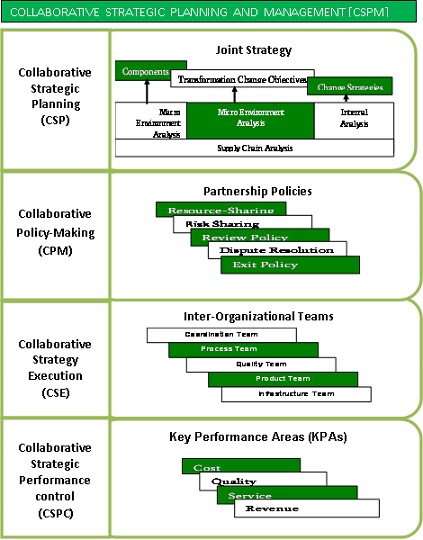
Collaborative Strategic Planning and Management (CSPM)


By the end of 20th century, industry analysts made a significant observation in terms of transformation in the global competitive scenario. Their vision is of a competitive arena where cohesive supply chain teams compete against other supply chains. Today, this network-level competition is shifting focus of business strategies towards supply chain-based, driving strategic collaboration with suppliers and partners.

Strategic collaboration among supply chain partners means strategic partnerships that would make the chain behave as a single system, coordinated with each element of the chain and aligned with a jointly established supply chain goal. These supply chain activities include not only logistics, but also product development and strategic planning. Companies not only have to contemplate sharing operational information (e.g., point-of-sale data, production schedules) but should also consider jointly developing strategic plans (e.g., capacity planning, network expansion, long-term supply chain goals, etc.  Such intensive collaboration involves member partners to cultivate strategic decision-making and enhance innovation in the chain. Which means shared goals and objectives of the strategic supply chain alliance should be planned by the partners jointly. Joint strategy to accomplish network goals/objectives should be designed by the partners. Relevant policies to govern and steer the strategic partnership should be framed, besides execution & control of joint strategies.  This is also often referred to as ‘Joint Decision-Making (JDM),’ defined as "joint authority and structure to carry out a common mission [in which] the parties engage in comprehensive planning and operate well defined communication channels. 

Historically, supply chain collaboration has been limited to coordinating operational efforts, but little has been done in the strategic arena, especially joint strategic planning. Thus far, collaborative efforts have focused on integrating operational processes, without integrating the planning and design activities, so, returns have been limited. One of the top-level findings from a supply chain survey is, the supply chain planning process is still not as robust as it should be.  In fact, this is one of the areas where the leaders appeared to be just as deficient as the followers and laggards. In strategic context of joint decision-making (JDM), coordination and integration functions (such as establishing shared goals, planning joint strategy, coordinating implementation, controlling collaborative performance, etc.,)  some of the major issues confronting strategic collaborations in supply chains are:  

What should be the framework for joint planning and decision-making? 
How to govern the strategic collaboration towards shared goals? 
How should supply chain partners manage the execution/implementation of joint strategy? 
What key performance areas (KPAs) should be monitored & controlled to achieve joint goal(s)?

These issues drive the need to determine:
i. Factors to be considered in joint planning
ii. Policy-related areas/concerns to be governed jointly
iii. Joint Mechanism for executing the joint strategy(s)
iv. Key performance areas (KPAs) to be monitored & controlled


None of the studies have so far, provided a comprehensive collaboration model that offers structured approach to better joint planning/decision-making, coordination and integration in the context of intensive supply chain collaboration. Hence, a comprehensive collaborative strategic management model that guides strategic supply chain partners to plan/govern/coordinate/execute/control together at strategic level collaboration is required which has been proposed in the ensuing discussion. The proposed model referred as ‘Collaborative Strategic Planning and Management (CSPM)' comprises four dimensions: 
1.       Collaborative Strategic Planning (CSP)

Devising a feasible joint strategy for the supply chain alliance is a complex challenge as each strategic global partner operates in a different economic, political, technical and regulatory climate. to craft an appropriate supply chain strategy it requires analyzing the macro environments of each and every strategic partner. The collaboration leader and strategic partners should together analyze their supply chain environment to develop and agree on the joint goals (see Supply Chain Collaboration: Joint Goal Planning). In the next stage, joint strategy is decomposed into many transformational change objectives or goals with timelines. However, these transformational objectives should be always viewed in relation with the competitors’ supply chains. to set realistic transformational supply chain goals the supply chain members should also assess the level of opportunities and threats/challenges prevailing in their micro environment before they fine-tune the transformational change goals. Next step involve development of the appropriate change strategies based on the transformational objectives by the collaboration leaders and strategic partners. Where to change and ultimately what to change to, for achieving each transformational change objective will be focus of developing change strategies. However, identification of what to change and where to change depends on determination of the strengths and limitations of each partner in the supply chain. As in any system, the supply chain partner is haunted by certain limitations that may be affecting the supply chain performance, which we refer to as supply chain constraints. Supply chain constraints can be broadly classified into internal and external to each partner. Whether internal or external constraint, all should be grouped and each limitation should be mapped to the transformational objectives. Those limitations/constraints if elevated can contribute to the transformational objective(s) should be considered as part of the change strategy of that objective(s). These change strategies should be mapped to the partners and be delegated for implementation to the respective partners in the supply chain.

2. Collaborative Policy-Making (CPM)

Steering the strategic partnerships in the supply chain to successfully implement joint strategy require governance of certain contractual relationships that is part of strategic collaboration. To bind all the partners together and guide them in the strategic process, a set of clear policies should be framed so that desired behaviors are exhibited in strategic collaboration. Incentive alignment, and risk and gain sharing, are argued to be key factors for the successful implementation of Supply Chain Management (SCM).

A firm can design incentive structures (Williamson 1983) that reward the necessary behaviors and/or penalize non-compliance in the ongoing relationship. Which means the dominant partner(s) and strategic partners should together agree on certain policies in areas that will govern their strategic relationships. In strategic alliances, the relationship factors that should be governed effectively are: resources and risks. Resource sharing JDM promotes cooperation over competition among the supply chain trading partners and aims to prepare the network for supply chain vs. supply chain competition. In doing so, the companies within the alliance should consider sharing resources with each other . Partners in the alliance should, therefore determine and agree upon what and how they will pool the resources from each other for executing their strategic plans. Similarly, the collaborative initiatives shall not only derive benefits but may also results in certain financial risks. So, the partners should together determine the type of risks involved, how they will address those risks, and if unavoidable, in what way they will share those risks.


In strategic partnerships, disputes between partners are common and sometimes inevitable too. So, there should be a mechanism that guides the partners to resolve their conflicts. Strategic partners of the supply chain collaboration should priorly determine what disputes are likely and agree on how they would settle those disputes. Similarly for any reason(s) or no reason(s), if any partner(s) wishes to disassociate from the partnership, it affects the strategic collaboration process. The point at which the respective member(s) want to disassociate themselves determines how it will influence the strategic collaboration. It may also influence the leaving partner(s) either positively or negatively. So, a detailed exit policy should be prepared before the strategic collaboration is started in order to avoid any disputes later.

Collaborative performance of the partnership or a team should be governed and controlled from time-to-time, to prevent under performance of the partners or to know whether all partners are performing as per the pre-determined expectations. But the question of how will the collaborative performance measured, how each partners contribution will be known and what guides the partners to control their own performance, what mechanisms should the partners employ to control their performance and how frequently they should meet to review their own performance, etc., should be answered and understood by all the partners prior to the commencement of the strategic collaborative exercise. So, a broad review policy should be developed by all the strategic partners together. Besides, broad guidelines should be stipulated for the strategy execution from instituting the implementation organization to defining the execution authority and mechanism for execution control.

3. Collaborative Strategy Execution (CSE)

Every partner in the collaboration is bound to execute the delegated part of the joint strategy. However, a coordination team drawn from the dominant and strategic partners will develop the implementation plan and coordinate the resources and program. Further, the coordination team will exclusively monitor and control the strategy implementation across the supply chain firms. For executing different parts of the strategy, inter-organizational teams comprising specialists/experts in the respective areas will be drawn from the associated supply chain members or sometimes hire consultants from outside.

Each cross-organizational team will be responsible for transforming a specific area as stipulated in the joint strategy. As per the joint-strategy and transformational objectives, these teams may focus on improving processes, instituting systems for enhancing quality, developing competitive products quickly and cost-effectively, or establishing the technology, logistics and production infrastructure. Usually the combination of any of the following inter-organizational teams is set up aligned with the joint strategy:
a. Process Team
b. Quality Team
c. Product Team
d. Infrastructure Team
e. Coordination Team

Each constituted team is provided with the set of transformational objectives and the appropriate change strategy to pursue. Their performance will be monitored and controlled in the ways as stipulated in the execution policy.

4. Collaborative Strategic Performance Control (CSPC)

Majority of supply chain metrics are in fact measures of internal logistics performance (Lambert and Pohlen, 2001), and can be considered inappropriate for the supply chain as a whole (Simatupang and Sridharan, 2002). Until holistic “supply chain” metrics are developed, the constituents of supply chain will not pursue common goal(s). A common review policy should guide how the members will measure their own performance and the collaborative performance.

Strategic performance of the alliance should be reviewed by dominant and strategic partners of the supply chain.
The pre-determined review policy will guide how the members will measure their own performance and the collaborative performance.  Performance of the supply chain alliance in various areas as focused by their joint strategy should be the guiding principle. The most important of supply chain performance drivers are cost focus, customer lead-time and customer quality, but these vary by sector. Financial perspective of the balanced scorecard views organizations as creating long-term shareholder value, and therefore builds from a productivity strategy of cost structure and asset utilization and a growth strategy of expanding opportunities and enhancing customer value. Therefore, focused areas such as cost, asset efficiency, service quality and revenue aligned with their shared vision should be assessed and compared against shared goals and industry performance standards.


Conclusion    
                       
Collaborative Strategic Planning and Management (CSPM)' provides a broad conceptual framework for strategic management in collaborative supply chains. It offers a holistic approach to effectively address strategic issues/challenges of the  supply chain collaborations. The framework guides strategic alliances (within supply chains) to  operate their network as one legal entity and optimizes supply chain integration paving way to collaborative performance. However, it is imperative to design a supply chain environment that facilitates strategic collaboration. Achieving strategic alignment among collaboration partners is crucial (see Supply Chain Collaboration: Achieving Strategic Alignment). Hence a high-level integration (collaborative relationship) among the supply chain partners should be developed. and such environment should be characterized with high-level of trust and relationship commitment between all the supply chain partners (see Supply Chain Collaboration: Evolution Management Framework). Further, the strategic relationship should comprise elements like process-orientation, multiple contact points at all levels of management, regular interaction, focus on end-customer value, flexible interfaces, two-way communication systems, cultural integration, realigned structures, technology exchange and adaptation, etc.